Facebook Live Sale Wednesday October 21 @ 6PM QLD


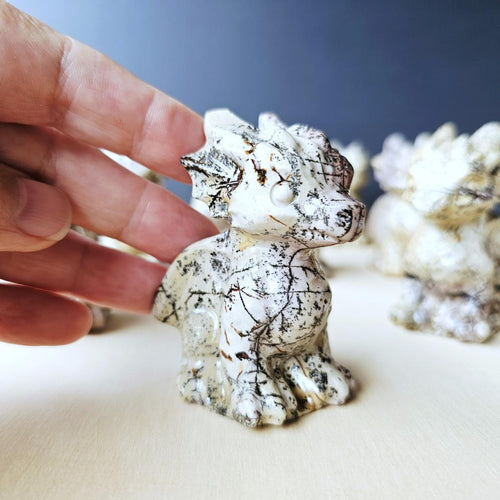

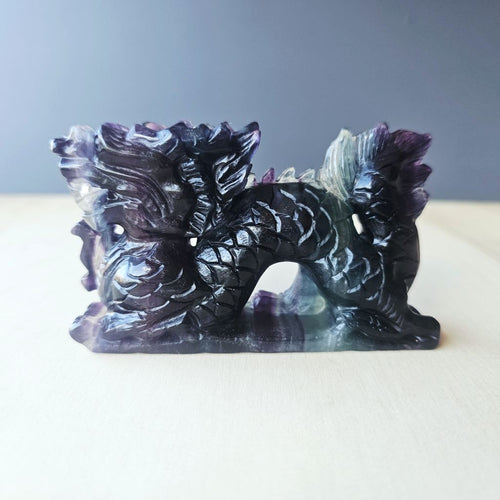

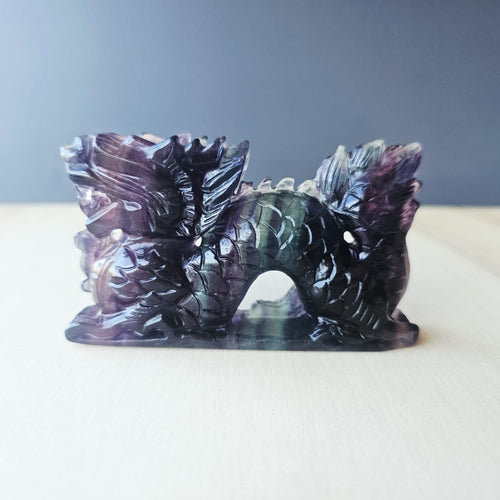

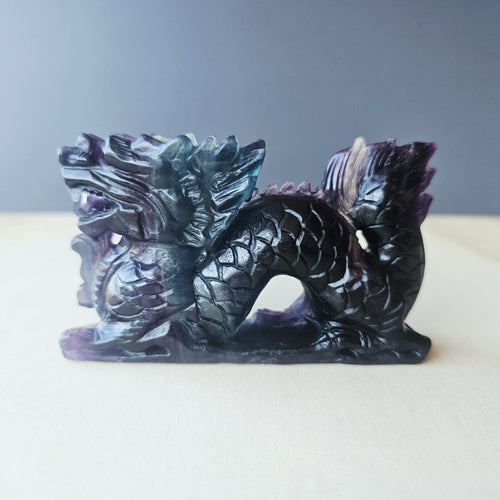



Crystal Dragons – Symbolism, Meaning & Mythology
Few mythical creatures have travelled through human imagination quite like the Dragon.
Across cultures and centuries, Dragons have represented extraordinary power. They have guarded kingdoms and treasure, controlled water and weather, battled heroes, represented emperors and appeared in mythology as creatures capable of inspiring both respect and fear.
Yet there is no single universal Dragon.
The elegant, serpentine Chinese Dragon carries a very different cultural history from the great winged Dragons familiar from European legend and modern fantasy. Even within individual traditions, the meaning of the Dragon has changed considerably over time.
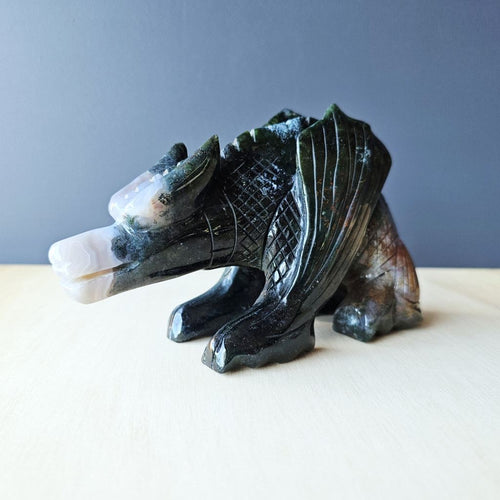
Our Crystal Dragon collection celebrates this remarkable variety. From traditional Chinese Dragons carved with flowing bodies and intricate scales to powerful winged Dragons with unmistakably Western and fantasy influences, each carving brings together mythology, lapidary skill and the natural character of crystal and stone.
The Chinese Dragon – Lóng (龙)
The Chinese Dragon, known as Lóng (龙), is one of the most significant creatures within Chinese mythology and visual culture.
Its history stretches back thousands of years, with Dragon imagery appearing in Chinese art as early as the Neolithic period.
Unlike the heavily winged, fire-breathing creature many people picture when they hear the word Dragon, the traditional Chinese Dragon usually has an elongated, serpentine body and does not require wings to fly.
Its appearance combines characteristics from several animals. Depending on the period and artistic tradition, Chinese Dragons may be depicted with horns, scales, claws, whiskers, flowing manes and long twisting bodies.
The Chinese Dragon belongs to the extraordinary world of Chinese mythical creatures, where legendary animals have carried layers of cultural symbolism for centuries.
Rather than being primarily portrayed as a monster to defeat, the Lóng became associated with auspicious power, success, protection, water, rainfall and eventually imperial authority.
Dragons, Water, Clouds & Life-Giving Rain
One of the most important differences between Chinese and many Western Dragon traditions is the Chinese Dragon's ancient relationship with water.
By the Han dynasty, Dragons were understood as creatures connected with rivers, oceans and moving water. They could rise into the clouds, influence weather and bring rain.
In an agricultural society where rainfall could determine whether crops flourished or failed, this was an extraordinary power.
The Dragon therefore became closely connected with fertility, abundance and the forces of nature that sustained life.
This explains why Chinese art so frequently depicts Dragons twisting through clouds, emerging from waves or moving amongst water.
Those clouds and waves aren't simply there because the artist thought the Dragon needed better scenery. 😂 They form part of a much older symbolic relationship between the Lóng, water and the heavens.
What Does a Chinese Dragon Symbolise?
Chinese Dragon symbolism is wonderfully layered.
Across different periods, Dragons have been associated with power, success, protection, happiness, fertility, abundance and auspicious fortune.
Their command over water and rain connected them with agricultural prosperity, while their ability to move between water, earth and sky gave them an almost limitless supernatural presence.
Over time, the Dragon also became strongly connected with imperial power.
This combination of natural force, authority and auspicious symbolism helps explain why the Dragon became one of the most enduring creatures within Chinese culture.
It represents strength, certainly, but strength alone barely scratches the surface.
The Chinese Dragon & Imperial Power
The Dragon eventually became one of the great visual symbols of imperial China.
During later imperial periods, Dragon imagery appeared extensively across robes, porcelain, architecture, furniture and decorative objects associated with the court.
The number of claws could communicate status.
Five-clawed Dragons became particularly associated with the emperor and the highest ranks of the imperial family, while Dragons with fewer claws could appear in other contexts.
This is one area where modern descriptions sometimes become a little too tidy. You may read that a five-clawed Dragon always represents the emperor and a four-clawed Dragon represents everyone else, but historical court regulations and usage were considerably more nuanced than that.
What remains clear is that Dragon imagery became deeply intertwined with imperial authority, prestige and the relationship between earthly rule and heavenly power.
What Is the Pearl With a Chinese Dragon?
One of the most beautiful motifs in Chinese Dragon imagery is the Dragon accompanied by a flaming pearl.
The pearl may appear beneath the Dragon's chin, between two Dragons or seemingly being pursued through clouds.
It has been interpreted in several ways throughout Chinese art rather than having one universally fixed meaning. Associations with wisdom, purity and something precious have all developed around the motif.
This uncertainty doesn't diminish the symbol. If anything, it makes it more interesting.
When we find crystal Dragon carvings incorporating a pearl, we therefore see much more than a decorative ball added because the Dragon needed something to hold.
It connects the carving with a visual motif that has appeared throughout centuries of Chinese art.
The Dragon Turtle & the Power of Combined Symbolism
The influence of the Chinese Dragon extends into other mythical creatures.
One of the most recognisable examples is the Dragon Turtle, or Longgui, which combines the characteristics of the Dragon and Turtle.
The Dragon contributes strength, success and auspicious power, while the Turtle represents longevity, wisdom, endurance and stability.
Together, they create a creature associated with prosperity and achievement supported by strong foundations.
It is a wonderful example of how Chinese mythical symbolism can combine the characteristics of different creatures to create an entirely new meaning.
Dragons, Qilin & Chinese Auspicious Creatures
Dragon characteristics also appear in other creatures within Chinese mythology.
The Qilin is a wonderful example. Its appearance has varied considerably throughout Chinese history, but traditional representations can combine characteristics of several animals, including a deer-like body and hooves with scales, horns and distinctly Dragon-like features.
Despite these shared characteristics, the Qilin and Dragon are separate mythical creatures with their own histories and symbolism.
The Qilin became particularly associated with benevolence, virtue and auspicious events. Its appearance was traditionally considered an exceptional omen and could be associated with the reign of a wise and virtuous ruler.
Together, the Dragon and Qilin demonstrate something we find fascinating about Chinese mythical creatures: their forms are rarely limited by the anatomy of one real animal. Features are combined deliberately, creating creatures whose appearance is as layered as their symbolism.
Chinese Dragons vs Western Dragons
Chinese and Western Dragons may share a name in English, but their histories developed very differently.
The Chinese Lóng is traditionally elongated and serpentine, closely associated with water, clouds, rain and auspicious power. Wings are generally unnecessary. A Chinese Dragon can simply fly because, frankly, when you control the weather you probably don't need to explain the mechanics. 😂
European Dragon traditions developed through a different collection of ancient, classical, Christian and medieval stories.
Western Dragons eventually became commonly depicted as large reptilian creatures with wings, claws and the ability to breathe fire, although historical representations vary considerably.
In medieval Christian traditions, Dragons could represent chaos, danger or evil and were frequently positioned as adversaries to saints and heroes. The story of Saint George defeating the Dragon became one of the best-known examples.
Other legends developed around Dragons guarding caves, territory, treasure or something of great value.
Modern fantasy has expanded the Western Dragon considerably further. Dragons may now be guardians, companions, ancient beings, intelligent teachers or powerful creatures with their own complex personalities.
There really isn't one Western Dragon any more than there is one universal Dragon mythology.
What Do Dragons Symbolise?
When we step beyond one particular cultural tradition, Dragon symbolism becomes enormous.
Dragons may represent:
Power and strength
Courage and determination
Protection and guardianship
Wisdom and knowledge
Transformation
Prosperity and success
Authority and leadership
Elemental power
Mystery and the unknown
Some traditions portray the Dragon as a protector.
Others make it the challenge that must be overcome.
And some manage to make it both.
This is part of the reason Dragons remain so compelling. They represent power in its many forms, including the power we admire, the power we seek and occasionally the power we'd be sensible not to annoy.
Winged Dragons & Western Dragon Carvings
Winged Dragons immediately create a different presence from the flowing form of the Chinese Lóng.
Their wings create height and movement, while horns, claws, scales and facial expression can dramatically change the personality of the carving.
Some appear protective and watchful. Others look as though they have tolerated humanity for quite long enough. 😂
From a carving perspective, winged Dragons are particularly demanding.
Thin wing membranes, individual claws, horns, teeth and scales all require careful work. The balance of the carving is equally important, particularly where wings extend significantly beyond the body.
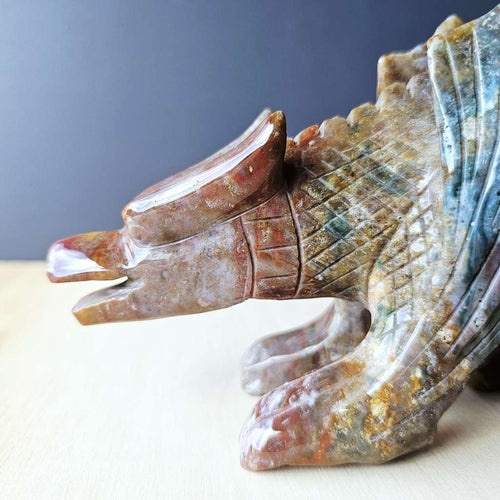
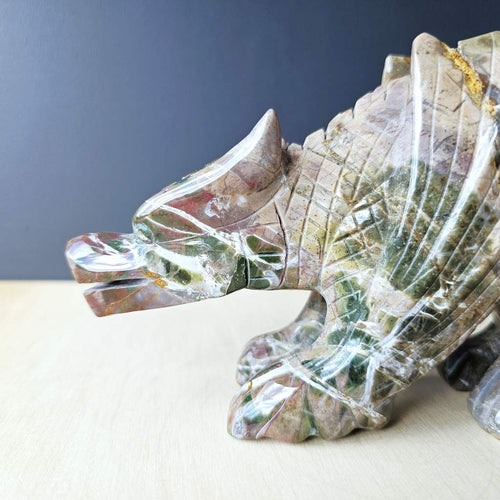
A well-carved Dragon should feel convincing from several angles rather than relying entirely on one impressive front view.
For collectors, these details can make the difference between an ordinary carving and one with genuine presence.
Choosing a Crystal Dragon
The mineral used for a Dragon can completely change the character of the finished carving.
Clear Quartz can reveal internal veils, fractures, inclusions and crystal formations beneath intricate carving.
Obsidian can create exceptional definition through scales, claws and facial details, particularly where sheen or natural patterning moves across the polished surface.
Fluorite can introduce colour zoning and translucency, while Jasper and Agate may give a Dragon dramatic natural patterning across its body.
Materials displaying flash, chatoyancy or other optical effects become particularly interesting when the carver has considered their orientation before beginning the piece.
A flash positioned across an eye, wing or scale can completely transform a carving as it is moved through the light.
For us, the strongest Crystal Dragons are those where neither the mineral nor the carving has been sacrificed for the other.
The Dragon should respect the stone it came from.
What Makes a Good Crystal Dragon Carving?
Dragons are wonderfully unforgiving subjects for a carver.
There is a lot going on.
Scales need definition without becoming visually chaotic. Claws should be recognisable. Facial features need expression. Horns, whiskers and wings may be delicate, and long serpentine bodies need convincing movement and proportion.
With Chinese Dragons, we particularly look at the flow of the body and how naturally the creature moves through the composition.
With Western-style Dragons, wings, posture, facial expression and balance become especially important.
Then we look at the stone.
Has the carver positioned interesting mineral features thoughtfully?
Does natural colour enhance part of the Dragon?
Has a flash been placed somewhere spectacular?
Do inclusions remain visible rather than being carved away unnecessarily?
The best crystal carvings aren't simply sculptures made from an attractive mineral. They show that the person carving them actually looked at the stone first.
Where Should I Place a Crystal Dragon?
There is no universal placement rule that applies to every Dragon from every cultural tradition.
Within modern Feng Shui practice, Chinese Dragons may be displayed in homes, offices and businesses in connection with success, opportunity, protection and auspicious energy.
A workspace can therefore be a meaningful location for someone who connects with the Dragon as a symbol of ambition, leadership or forward movement.
Western and fantasy-style Dragons are generally less constrained by traditional placement ideas and can simply be positioned where their form and character can be appreciated.
For larger collector pieces, viewing angle deserves consideration.
A Dragon with an intricate back, sweeping tail or detailed wings shouldn't spend its entire existence facing a wall where half the workmanship disappears.
Lighting can also reveal natural features within the mineral, although prolonged direct sunlight should be avoided for stones known to be light sensitive.
The Meaning Behind Our Crystal Dragon Collection
Dragons are one of the carving styles we particularly enjoy sourcing because the possibilities are almost endless.
During our buying trips to China, we encounter everything from traditional Chinese Lóng to powerful winged Dragons and contemporary interpretations that borrow elements from mythology and fantasy.
We look for pieces with personality.
Some Dragons capture our attention through exceptional carving detail. Others begin with an extraordinary piece of crystal that the carver has clearly understood.
The most interesting examples manage both.
Natural colour may become part of a wing. An inclusion may sit beneath the scales. Flash may travel across the body as the Dragon moves through the light. A mineral formation that could have been considered an imperfection becomes one of the most interesting features of the finished piece.
We also appreciate that people choose Dragons for very different reasons.
Some connect deeply with Chinese symbolism and culture. Others are drawn to Western mythology, fantasy, protection, strength or simply the extraordinary visual presence of the creature.
There is room for all of it within this collection.
After thousands of years of Dragon mythology, it seems rather unfair to give them only one job.
Crystal Dragon FAQs
What does a Dragon symbolise?
Dragon symbolism depends greatly on the culture and tradition.
Chinese Dragons are strongly associated with auspicious power, water, rainfall, success, protection and imperial authority. Western traditions have variously associated Dragons with strength, danger, guardianship, treasure, chaos and challenges that must be overcome.
Modern interpretations may also connect Dragons with courage, transformation, wisdom and personal power.
What is a Chinese Dragon called?
The Chinese word for Dragon is Lóng (龙).
The Chinese Dragon has an ancient history and is generally depicted with an elongated, serpentine body, scales, claws, horns and other animal characteristics.
Are Chinese Dragons lucky?
Chinese Dragons have long carried strongly auspicious associations.
They have been connected with protection, happiness, fertility, success and prosperity, as well as the rain and water necessary for agricultural abundance.
Their symbolism can vary according to period and context, but the Chinese Dragon is generally very different from the destructive monster commonly found in some Western traditions.
Do Chinese Dragons breathe fire?
Fire breathing is not a defining characteristic of the traditional Chinese Lóng.
Chinese Dragons are much more closely associated with water, rivers, oceans, clouds, weather and rain.
The familiar fire-breathing Dragon is primarily associated with later Western and modern fantasy imagery.
Do Chinese Dragons have wings?
Traditional Chinese Dragons generally do not require wings to fly.
Their long, serpentine bodies are commonly shown moving through clouds or across the sky without visible wings.
Some Chinese mythological traditions do include winged dragon-like creatures, but wings are not a requirement for the classic Lóng.
What does the pearl with a Chinese Dragon mean?
The flaming pearl is an important motif in Chinese Dragon imagery.
It has been associated with concepts including wisdom and purity and forms part of a broader auspicious artistic tradition. Interpretations have varied, so it is better understood as a layered historical symbol rather than something with one single fixed meaning.
Why do Chinese Dragons have five claws?
Not every Chinese Dragon has five claws.
During later imperial periods, five-clawed Dragons became strongly associated with the emperor and the highest levels of the imperial family and court.
Dragons with fewer claws appeared in other contexts, and the exact rules varied according to dynasty, rank and period.
What is the difference between a Dragon and a Qilin?
The Dragon and Qilin are separate creatures within Chinese mythology, although traditional representations of Qilin can incorporate Dragon-like features such as scales, horns and the shape of the head.
Chinese Dragons are particularly associated with water, rainfall, auspicious power and imperial authority. Qilin have their own traditions and are particularly associated with benevolence, virtue and highly auspicious events.
What is the difference between a Chinese Dragon and a Western Dragon?
Chinese Dragons are generally serpentine, usually wingless and strongly associated with water, clouds, rainfall and auspicious power.
Western Dragons are commonly represented as large reptilian creatures with wings and, particularly in later traditions, fire-breathing abilities.
Western mythology also contains many stories in which Dragons are adversaries, guardians or dangerous creatures, although both historical and modern interpretations are much broader than this simple distinction suggests.
What crystal is best for a Dragon?
There is no single best crystal for a Dragon.
The choice may depend on the natural properties and appearance of the mineral, the quality of the carving or the symbolism you personally associate with the stone.
For collectors, we recommend looking at the relationship between the material and the carving. An exceptional mineral can make a Dragon interesting, but thoughtful workmanship is what allows that material to become part of the creature.
Are Crystal Dragons good collector pieces?
Absolutely.
Dragons can be technically complex carvings, particularly where individual scales, claws, horns, whiskers, wings and facial features have been carefully defined.
Collector-quality examples become particularly interesting when the carver has also worked intelligently with natural inclusions, colour zoning, flash, transparency or other mineral features.
A strong Crystal Dragon should reward inspection from more than one angle.