Facebook Live Sale Wednesday October 21 @ 6PM QLD


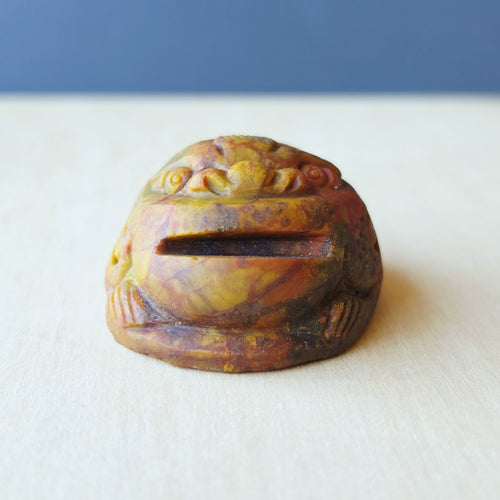

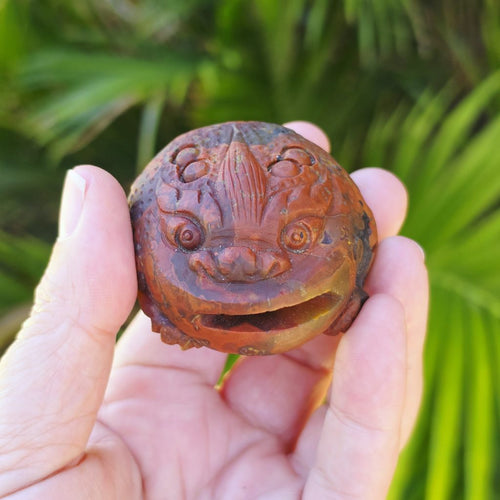


The Three-Legged Money Toad – Jin Chan Symbolism & Meaning
The Three-Legged Money Toad, known as Jin Chan (金蟾), is one of the most recognisable symbols of prosperity and good fortune within Chinese culture.
Often called the Money Frog in English, Jin Chan is more accurately a toad, distinguished by its unusual three-legged form. Modern carvings frequently depict the creature surrounded by Chinese coins, carrying a coin in its mouth or sitting amongst ingots, creating an unmistakable connection with wealth and abundance.
Our Three-Legged Money Toad collection brings this traditional symbolism into crystal and stone carving. Different materials give each Jin Chan its own personality, with natural patterning, inclusions, druzy formations, translucency and colour all influencing the finished creature.
The Money Toad in Chinese Tradition
Jin Chan belongs to the fascinating world of Chinese mythical creatures, where legendary animals and auspicious symbols have developed layers of meaning over centuries.
The history of the three-legged toad reaches further back than the familiar modern Money Toad surrounded by coins. Toad imagery has ancient connections with the moon and ideas surrounding longevity and immortality within Chinese culture, while the three-legged toad later developed strong associations with prosperity and auspicious fortune.
One of its best-known connections is with Liu Hai, also known as Liu Haichan, a legendary Daoist figure frequently depicted alongside a three-legged toad and strings of traditional Chinese cash coins.
Different versions of the story developed over time, but the relationship between Liu Hai, the toad and coins became an enduring motif within Chinese art and folklore. Over the centuries, this imagery increasingly became associated with prosperity, good fortune and wealth.
Today, Jin Chan is particularly recognised as an auspicious prosperity symbol and appears throughout Chinese decorative arts, carvings and contemporary Feng Shui practice.
What Does a Three-Legged Money Toad Symbolise?
The Three-Legged Money Toad is traditionally associated with prosperity, abundance, financial opportunity and good fortune.
Its modern symbolism is particularly connected with acquiring and retaining wealth. This is why many Jin Chan carvings feature additional prosperity symbols, including traditional Chinese cash coins and yuanbao ingots.
The coin held in the mouth of many contemporary Money Toads makes the message wonderfully difficult to miss. Jin Chan certainly isn't subtle about his department. 😂
For business owners, the Money Toad has become particularly popular as a symbol of commercial prosperity and financial growth. Within the home, it may instead represent abundance, financial stability or the intention to build greater prosperity over time.
Why Does the Money Toad Have Three Legs?
The three-legged form is one of the defining characteristics of Jin Chan and distinguishes the mythical Money Toad from an ordinary frog or toad.
Numerous legends have developed to explain its unusual anatomy, particularly through later stories involving Liu Hai. However, there is no single historical account that can be treated as the definitive explanation for the missing fourth leg.
What we do know is that three-legged toad imagery has a long history within Chinese culture and eventually became closely connected with the auspicious creature recognised today as Jin Chan.
For collectors, those three legs are therefore an important part of identifying the traditional subject rather than simply an unusual decision made by the carver.
Coins, Ingots & Symbols on a Money Toad
The details surrounding a Three-Legged Money Toad can add further layers to its meaning.
Many contemporary Jin Chan carvings sit upon Chinese coins or yuanbao ingots, both strongly associated with prosperity and wealth. Others hold a traditional Chinese cash coin in their mouth, often recognisable by its round shape and central square opening.
Some carvings are wonderfully elaborate, with coins, ingots and other auspicious details incorporated throughout the design. Others allow the Money Toad itself and the natural character of the stone to take centre stage.
These additional features can make Jin Chan particularly interesting as a crystal carving because there is considerably more happening than first meets the eye. A good piece rewards being turned around and examined from every angle.
Money Toad, Pixiu & Chinese Prosperity Symbols
Jin Chan is one of several Chinese creatures traditionally connected with prosperity.
Another is Pixiu, a mythical guardian strongly associated with wealth, good fortune and protection. While the two are sometimes displayed for similar intentions, their histories and symbolism are distinctly different.
Pixiu is a powerful hybrid mythical beast, while Jin Chan takes the unmistakable form of a three-legged toad. Both have become particularly popular within businesses and modern Feng Shui traditions, making them two of the most recognisable Chinese prosperity creatures.
The Dragon Turtle carries another interpretation of prosperity, combining the strength and success associated with the Dragon with the longevity, stability and endurance represented by the Turtle.
Together, these creatures demonstrate how richly Chinese tradition expresses ideas surrounding fortune, success and prosperity, with each symbol bringing its own history and character.
Choosing a Crystal Money Toad
The stone chosen for a Three-Legged Money Toad can dramatically change the appearance of the carving.
Obsidian can give Jin Chan a strong, sculptural presence and beautifully define carved details such as coins, eyes and skin texture. Quartz varieties may reveal internal veils, inclusions and natural formations, while Agate and Jasper can introduce banding, pattern and striking changes of colour across the body.
Some of our favourite Money Toads are those where the carver has allowed the mineral itself to participate in the design.
Natural pockets, druzy formations, colour changes and inclusions can appear across the body, mouth or base of the carving, creating details that could never be exactly repeated in another piece.
When selecting a collector-quality Money Toad, we look at the quality and interest of the mineral alongside the carving itself. Expression, proportions, detail around the feet and eyes, the treatment of coins or ingots and the overall finish can make an enormous difference to the character of the finished Jin Chan.
Where Should I Place My Money Toad?
Within modern Feng Shui traditions, Money Toads are commonly displayed in homes, offices and businesses because of their association with prosperity and financial opportunity.
One popular placement tradition is to position Jin Chan near an entrance but facing into the space rather than directly out through the door. Symbolically, this represents prosperity entering and remaining within the home or business rather than leaving it.
A business counter, office, workspace or area associated with finances may also be chosen.
Placement traditions can vary, however, and the cultural history of the three-legged toad is considerably older and more complex than many of the highly specific placement rules now found online.
For crystal collectors, there is also absolutely nothing wrong with choosing a position simply because it displays the carving beautifully.
Consider the individual mineral when selecting its location, particularly if the stone may be affected by prolonged direct sunlight.
The Meaning Behind Our Money Toad Collection
Money Toads are one of those carvings that become considerably more interesting once you understand what you are looking at.
During our buying trips to China, we look for Jin Chan carvings with character. The quality of the material matters, but so does expression, detail and the way the carver has approached the individual stone.
Some are traditional and immediately recognisable, sitting proudly amongst coins and ingots. Others are much more unusual, particularly when natural crystal formations, druzy pockets or distinctive mineral patterns have been incorporated into the carving.
We particularly enjoy finding examples where the material hasn't simply been used to create the shape of the Money Toad, but has influenced the finished carving itself.
It brings together three things we appreciate enormously: Chinese cultural symbolism, skilled lapidary work and the individuality of natural stone.
Three-Legged Money Toad FAQs
What is a Three-Legged Money Toad?
A Three-Legged Money Toad, known as Jin Chan (金蟾), is an auspicious creature within Chinese tradition. It is commonly depicted with three legs and may be surrounded by Chinese coins or ingots or shown carrying a coin in its mouth.
It is also widely known in English as the Money Frog, although Money Toad is the more accurate description.
What does Jin Chan mean?
Jin Chan (金蟾) translates as Golden Toad. The name refers to the mythical toad that became strongly associated with prosperity and good fortune within Chinese culture.
What does a Money Toad symbolise?
Jin Chan is associated with prosperity, abundance, financial opportunity and good fortune. Contemporary Money Toad carvings often reinforce this symbolism through Chinese coins, yuanbao ingots and other prosperity motifs.
Why does a Money Toad have three legs?
Three legs are a defining characteristic of the mythical Jin Chan. Various legends offer explanations for the missing fourth leg, but there is no single universally accepted historical explanation.
The three-legged form has a long history within Chinese imagery and ultimately became one of the easiest ways to distinguish Jin Chan from an ordinary toad.
Is it a Money Frog or Money Toad?
Both names are commonly used in English.
Money Frog has become extremely popular within Feng Shui terminology, but Jin Chan is traditionally represented as a three-legged toad. For this reason, Three-Legged Money Toad is the more precise description.
What is the difference between a Money Toad and Pixiu?
Both Jin Chan and Pixiu are Chinese auspicious creatures associated with prosperity and good fortune, but they are entirely different figures.
Jin Chan is the mythical three-legged toad strongly associated with coins and wealth, while Pixiu is a hybrid mythical guardian traditionally connected with prosperity and protection.
Where should I place a Money Toad?
Modern Feng Shui traditions commonly place Jin Chan within a home, office or business. A popular placement is near an entrance with the Money Toad facing inward, symbolically welcoming prosperity into the space.
It may also be displayed on a desk, in a workspace or amongst a crystal collection.
Should a Money Toad face the front door?
Modern Feng Shui practices commonly recommend positioning a Money Toad near an entrance while facing into the home or business rather than directly outward.
These placement customs can vary, however, and they should not be confused with the much older cultural history of Jin Chan itself.
Are crystal Money Toads good collector pieces?
They certainly can be.
A well-carved Jin Chan combines cultural symbolism with lapidary craftsmanship and the natural characteristics of the mineral. Unusual materials, exceptional patterning, druzy formations, inclusions and particularly detailed carving can make individual Money Toads especially appealing to crystal and carving collectors.