Facebook Live Sale Wednesday October 21 @ 6PM QLD






The Nine-Tailed Fox – Jiǔwěihú Symbolism & Meaning
The Nine-Tailed Fox, known in Chinese as Jiǔwěihú (九尾狐), is one of the most fascinating creatures within ancient Chinese mythology.
Elegant, intelligent and surrounded by centuries of evolving folklore, the Nine-Tailed Fox has carried very different meanings throughout Chinese history. Early accounts describe a mysterious creature from the legendary land of Qingqiu, while later traditions developed increasingly complex stories surrounding fox spirits, transformation, beauty, intelligence and supernatural ability.
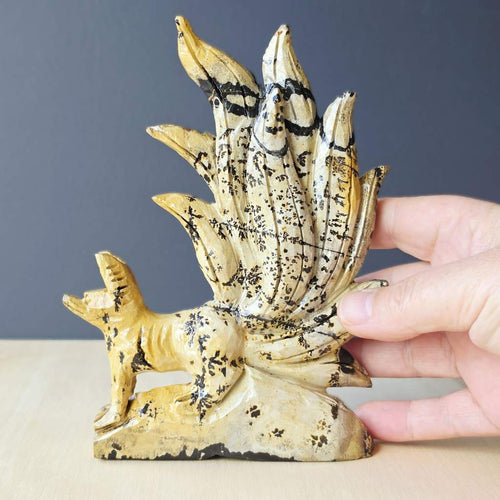
Today, the sweeping nine tails make the fox an extraordinary subject for crystal carving. Each tail gives the carver an opportunity to work with movement, balance and the natural features of the stone, creating pieces that can appear graceful, powerful or wonderfully dramatic depending on the material.
The Nine-Tailed Fox in Chinese Mythology
The Nine-Tailed Fox belongs to the remarkable world of Chinese mythical creatures, with references reaching back into some of China's earliest surviving mythological literature.
One of its best-known ancient appearances occurs in the Shan Hai Jing, or Classic of Mountains and Seas, a collection of geographical descriptions, mythology, strange creatures and supernatural beings compiled from ancient Chinese traditions.
Within the text, a creature resembling a fox with nine tails is described at Qingqiu Mountain. Its cry is said to resemble the voice of an infant, and the account gives the creature a considerably wilder character than many modern interpretations of the Nine-Tailed Fox.
This early Jiǔwěihú is important because it shows just how old the creature is within Chinese tradition.
Over subsequent centuries, however, its meaning did not remain fixed.
The Nine-Tailed Fox appeared in later writings as an auspicious creature whose arrival could signify favourable conditions, peace, prosperity and flourishing descendants. At other times, fox spirits developed more mysterious and potentially dangerous associations.
It is this ability to move between the auspicious and the mysterious that makes the history of the Nine-Tailed Fox so intriguing.
What Does the Nine-Tailed Fox Symbolise?
There is no single meaning that captures the entire history of the Nine-Tailed Fox.
Across different periods of Chinese tradition, the Jiǔwěihú has been associated with auspicious fortune, prosperity, intelligence, transformation, longevity, beauty and supernatural power.
Later fox-spirit traditions also developed strong associations with charm, attraction and the ability to influence or captivate others.
This is partly why modern Nine-Tailed Fox symbolism can vary considerably depending on where you encounter it.
For some, the fox represents confidence, attraction and personal magnetism. For others, it is connected with intelligence, adaptability and transformation. Its much older history also includes distinctly auspicious interpretations associated with prosperity and flourishing future generations.
Rather than forcing centuries of mythology into one neat meaning, we think its complexity is precisely what makes the Jiǔwěihú so interesting.
Why Does the Nine-Tailed Fox Have Nine Tails?
Nine is an especially significant number within traditional Chinese culture and has long carried associations with completeness, longevity and power.
Later Chinese texts gave specific symbolic meaning to the nine tails of the fox. Some associated them with abundant descendants and future prosperity, while the creature itself could appear as an auspicious omen during periods of good governance and peace.
The nine tails eventually became the defining visual feature of the Jiǔwěihú.
For crystal carvers, they also create quite the assignment. 😂
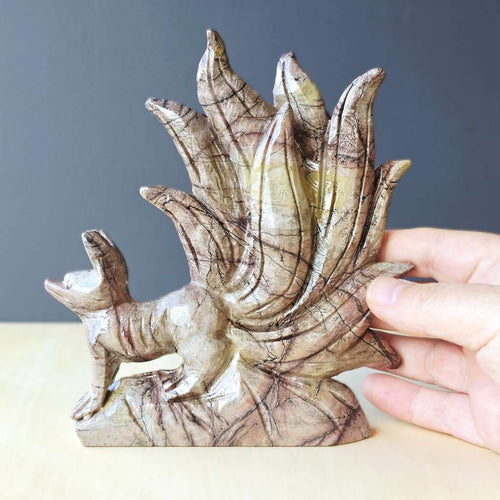
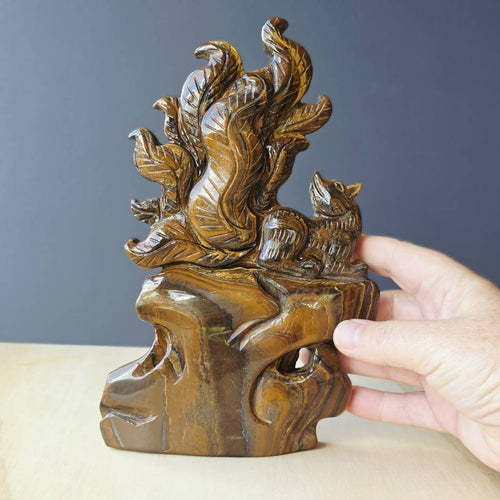
Unlike a simple animal carving, a Nine-Tailed Fox requires the tails to be individually defined while still forming a balanced composition. They may sweep around the body, rise behind the fox like a fan or curl around the base of the carving.
When done particularly well, the nine tails create movement from every angle.
Fox Spirits, Transformation & Beauty
As Chinese fox folklore developed, fox spirits became increasingly associated with intelligence, transformation and supernatural ability.
Stories emerged of foxes cultivating spiritual power over long periods of time and gaining extraordinary abilities, including the capacity to assume human form.
Beautiful women became particularly prominent within later fox-spirit stories, giving the fox enduring associations with beauty, attraction, charm and seduction.
But Chinese fox folklore is rarely quite that simple.
Fox spirits could be benevolent, mischievous, wise, romantic, dangerous or deceptive depending on the story and historical period. Some rewarded kindness. Others caused considerable trouble.
That ambiguity is part of their appeal.
The fox is intelligent rather than predictable, beautiful without necessarily being innocent, and capable of transformation in both literal and symbolic senses.
Perhaps that explains why the Nine-Tailed Fox has remained culturally fascinating for so long. She was never destined to be boring.
Is the Nine-Tailed Fox Chinese or Japanese?
The Nine-Tailed Fox has an ancient history in China, with the Jiǔwěihú appearing in Chinese literature long before many of the later traditions now familiar across East Asia.
Fox mythology subsequently developed throughout China, Japan and Korea, with each culture creating its own stories and interpretations.
In Japan, fox spirits became closely associated with kitsune traditions, while Korea developed its own folklore surrounding the gumiho.
Although these traditions share historical influences, they should not simply be treated as different names for exactly the same creature.
Our Nine-Tailed Fox collection focuses primarily on the Chinese Jiǔwěihú and the cultural history surrounding this remarkable mythical fox.
Choosing a Crystal Nine-Tailed Fox
Few mythical creatures give a crystal carver quite as much opportunity to play with the natural stone as the Nine-Tailed Fox.
The large arrangement of tails creates multiple surfaces across which colour, inclusions, flash, transparency and natural patterning can appear.
In materials with optical effects, the orientation of the carving becomes particularly important. A well-positioned flash can travel across a tail, face or body as the piece is moved, while patterned stones can create entirely different markings across each individual tail.
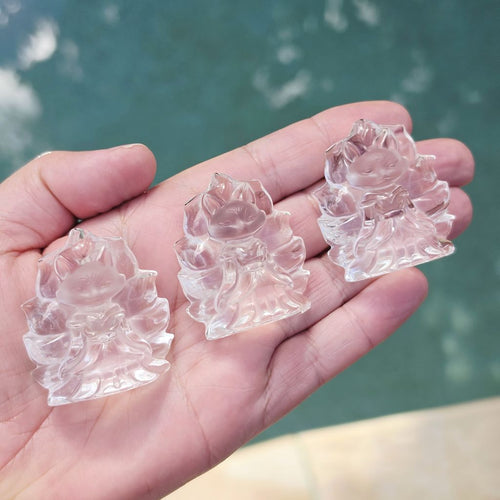
Clearer Quartz materials allow internal inclusions and formations to remain visible through the carving. Obsidian can create striking definition through the face and tails, while Fluorite, Moonstone, Agate, Jasper and other materials each bring their own mineral character to the form.
For us, a beautiful Nine-Tailed Fox needs more than nine technically correct tails.
We look at the expression of the face, the proportions of the body, how naturally the tails flow together, the quality of the polish and, importantly, whether the carver has understood the individual piece of stone they were working with.
Where Should I Place a Nine-Tailed Fox?
Unlike Jin Chan or Pixiu, the Nine-Tailed Fox does not have one universally established traditional placement rule.
Modern spiritual and Feng Shui interpretations sometimes place Nine-Tailed Fox carvings in areas associated with relationships, confidence, attraction or personal development. These ideas largely reflect contemporary interpretations of the fox's associations with beauty, magnetism and transformation rather than one single ancient placement tradition.
For this reason, we prefer not to invent strict rules where history doesn't provide them.
A Nine-Tailed Fox can be displayed wherever its symbolism or appearance feels meaningful to you.
For a larger collector carving, lighting and viewing angle may actually be more important. Positioning the piece where its nine tails can be appreciated from several directions allows the workmanship and natural characteristics of the mineral to be seen properly.
As always, consider the individual stone and avoid prolonged direct sunlight where the mineral is known to be light sensitive.
The Meaning Behind Our Nine-Tailed Fox Collection
Nine-Tailed Foxes are particularly interesting for us to source because there is enormous variation in both the carving and the material.
During our buying trips to China, we look beyond simply finding another fox with nine tails.
Expression matters. Movement matters. The way the tails have been arranged matters.
And then there is the stone itself.
Some carvings are beautiful because of their symmetry and polish, while others become exceptional because the carver has positioned a natural flash, inclusion, crystal formation or colour transition exactly where it brings the creature to life.
We particularly enjoy finding pieces where you need to turn them around and look again.
Nine tails give a carver nine opportunities to do something interesting, after all. 🦊
For us, the best examples bring together the long cultural history of the Jiǔwěihú, skilled lapidary work and a mineral interesting enough to hold its own beside the mythology.
Nine-Tailed Fox FAQs
What is a Nine-Tailed Fox?
The Nine-Tailed Fox, or Jiǔwěihú (九尾狐), is a mythical fox with nine tails that appears in ancient Chinese mythology and later folklore.
One of its earliest well-known appearances is in the Shan Hai Jing, where a nine-tailed fox-like creature is associated with Qingqiu.
What does Jiǔwěihú mean?
Jiǔwěihú (九尾狐) literally means Nine-Tailed Fox.
Jiǔ means nine, wěi refers to tail, and hú means fox.
What does the Nine-Tailed Fox symbolise?
Its symbolism has changed considerably throughout Chinese history.
The Nine-Tailed Fox has been associated with auspicious fortune, prosperity, flourishing descendants, intelligence and supernatural power. Later fox-spirit traditions also introduced strong associations with transformation, beauty, charm and attraction.
Is the Nine-Tailed Fox lucky?
In some Chinese traditions, yes.
Historical texts describe the appearance of a Nine-Tailed Fox as an auspicious sign associated with peace, good governance and prosperity. However, later fox-spirit folklore became much more complex, so the fox has not always been portrayed purely as a symbol of good fortune.
Is the Nine-Tailed Fox associated with love?
Modern interpretations frequently connect the Nine-Tailed Fox with love, attraction, confidence and personal magnetism.
These associations have some relationship with later fox-spirit traditions surrounding beauty and charm, but describing the ancient Jiǔwěihú simply as a love symbol overlooks a much broader cultural history.
Why does the fox have nine tails?
Nine carries considerable symbolic importance within Chinese culture, and later texts connected the nine tails with flourishing descendants and prosperity.
The nine tails eventually became the defining physical characteristic of the Jiǔwěihú and are now instantly recognisable in traditional and contemporary depictions.
Is a Nine-Tailed Fox the same as a kitsune?
Not exactly.
Jiǔwěihú belongs to Chinese tradition, while kitsune refers to foxes within Japanese folklore. Chinese fox mythology influenced later East Asian traditions, but Japanese kitsune developed their own cultural stories, religious associations and characteristics.
Korea likewise developed its own Nine-Tailed Fox tradition surrounding the gumiho.
Where should I place a crystal Nine-Tailed Fox?
There is no single historically established placement rule that applies to every Nine-Tailed Fox.
You may choose a location based on its symbolism, the crystal from which it has been carved or simply where the carving can best be appreciated.
For detailed collector pieces, consider a position that allows the tails and natural mineral features to be viewed from several angles.
Are crystal Nine-Tailed Foxes good collector pieces?
Absolutely.
The complexity of nine individually carved tails makes the Jiǔwěihú an excellent subject for evaluating lapidary workmanship. When combined with an interesting mineral, natural inclusions, optical effects or unusual patterning, the result can be particularly impressive.
For collectors, the strongest examples combine quality material, thoughtful carving, balanced proportions and a clear understanding of the natural stone.