Facebook Live Sale Wednesday October 21 @ 6PM QLD


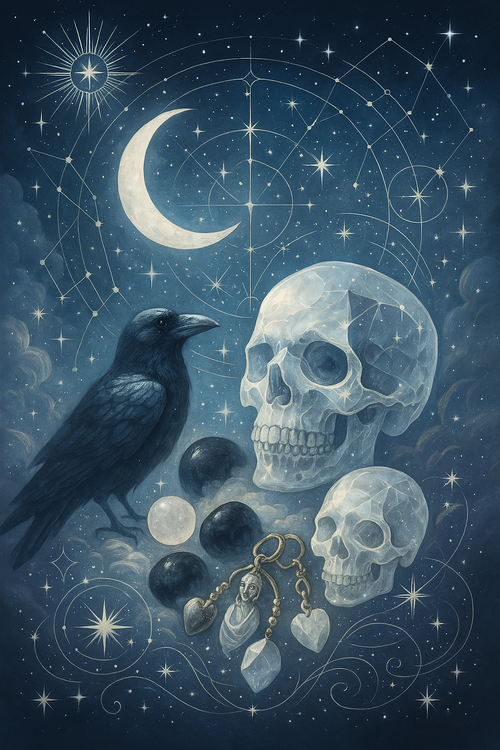
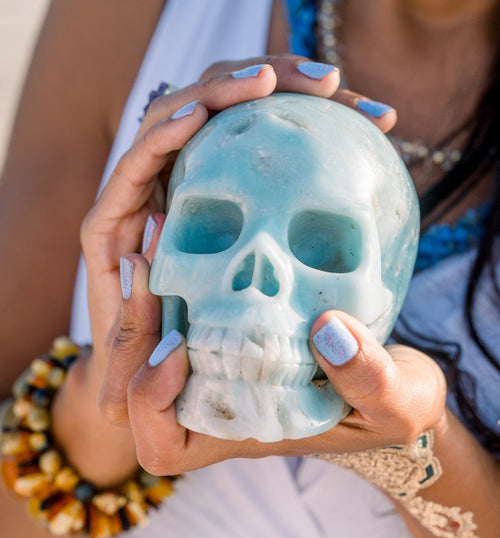
Crystal skulls are curious things.
Few crystal carvings seem to provoke such an immediate reaction.
Some people love them. Some dislike them. Some are fascinated by them without really understanding why. And then there are those who take one look at a particular skull and seem to know immediately that it belongs with them.
I used to belong firmly in the group that didn't like them.
Which was rather inconvenient considering Niome did. 😂
I could appreciate the workmanship. I could see when a skull had been exceptionally carved, when the jawline was beautifully defined, when the proportions were balanced and when an extraordinary piece of crystal had been chosen for the carving.
But personally?
No thank you.
For a long time, I couldn't really explain why.
Then one conversation, and an unexpected encounter at the MindBodySpirit Festival in Brisbane, made me realise that perhaps my reaction had very little to do with skulls at all.
It had to do with my brother Martin.
Why I Didn't Always Love Crystal Skulls
I have experienced the deaths of people I loved from quite early in my life, and those losses affected me deeply.
My brother Martin's passing particularly stayed with me.
For a long time, I don't think I consciously connected those experiences with my dislike of skulls.
Then Niome and I were talking with one of our beautiful crystal friends who had called to thank us for her delivery.
Somehow the conversation moved to skulls and the connection people can have with them.
And suddenly I understood.
I associated skulls with death.
Not death as an abstract idea.
I associated them with grief.
Loss.
People I loved who were no longer physically here.
Once I recognised that, another memory came flooding back.
Several years earlier, Niome and I were exhibiting at the MindBodySpirit Festival in Brisbane.
Our stall was positioned on a corner and, right in that corner, was a substantial display of Crystal Skulls, most of which Niome had chosen.
During an incredibly busy day, an older lady approached our stall.
She didn't know me.
She began telling me that she had a message from someone connected to me.
Then she looked towards the skull display.
She told me there was a masculine energy standing there in front of the skulls.
She said he was connected to me.
And then she told me:
He is proud of you, and he loves you.
I cried.
And suddenly, from somewhere in that enormous internal filing cabinet where memories disappear until something unlocks them, I remembered one of Martin's tattoos.
It was a skull.
Martin loved his tattoos, just as I love mine.
Yet somehow I'd completely forgotten that particular detail about him.
The lady and I hugged before she left, and I remember standing there afterwards, surrounded by customers in the middle of an incredibly busy festival, thinking:
Martin would absolutely love our Crystal Skulls.
He probably would have been one of our best customers. 😂
Something changed for me that day.
When the Meaning of a Skull Changes
I didn't suddenly decide that skulls represented one particular spiritual meaning.
Something much simpler happened.
I stopped seeing only death.
The skull that had previously reminded me of loss suddenly reminded me of Martin.
His tattoos.
His personality.
His memory.
And eventually, rather than connecting skulls only with the pain of somebody being gone, I could also connect them with the fact that somebody had been here.
That distinction became incredibly important to me.
My story is only one story.
Someone else may look at a skull and see transformation.
Another person may see mortality.
Someone may see strength, ancestry, remembrance, protection or simply extraordinary carving.
And someone else may still look at one and think, absolutely not. 😂
That's okay too.
Because there has never been one universal meaning of the skull.
Human beings have been giving skulls meaning for thousands of years.
And those meanings are far more complex than death alone.
Why Are Skulls Such Powerful Symbols?
The human skull is instantly recognisable.
Strip away hair, skin, expression, clothing, age, status and many of the other things we use to distinguish ourselves, and underneath sits essentially the same fundamental structure.
Perhaps that's part of why skull imagery can be so confronting.
It is deeply human while simultaneously reminding us of something many of us prefer not to think about.
Mortality.
But throughout history, mortality has rarely been the end of the skull's symbolism.
Depending on the culture, period and context, skull imagery has been connected with remembrance, ancestors, sacrifice, renewal, spirituality, impermanence, protection, transformation and the cycles of life and death.
The important words there are "depending on the culture".
There is no single ancient Skull Meaning that belongs equally to every civilisation.
Context matters.
Skulls, Death & Renewal in Ancient Mesoamerica
Skull imagery held significant roles within several Mesoamerican cultures.
One of the most dramatic examples was the tzompantli, a structure used to display human skulls, including those of people who had been sacrificed.
To modern eyes this can appear simply macabre.
Within the societies that created them, however, the meaning existed within much larger religious and cosmological systems involving sacrifice, fertility, cosmic balance and the relationship between death and the continuation or renewal of life.
Skull imagery also appeared in sculpture and architecture.
For the Mexica, death was not necessarily understood simply as an ending isolated from life. Death and renewal could exist within the same cosmological cycle.
That does not mean every skull carving today carries ancient Mesoamerican meaning.
And it certainly doesn't mean modern Crystal Skulls are direct descendants of these objects.
But it demonstrates something important.
Even where skull imagery was explicitly connected with death, its symbolism could extend far beyond death alone.
Memento Mori: Remember That You Will Die
Across the Atlantic, skull imagery developed very different meanings within European art and religious culture.
One particularly fascinating tradition is memento mori.
The Latin phrase translates approximately as "remember that you must die".
Cheery. 😂
But the intention wasn't necessarily morbid.
A memento mori reminded the viewer that life was temporary.
Skulls appeared alongside clocks, extinguished candles, wilting flowers and other symbols of passing time.
The message was essentially:
Life doesn't last forever.
What are you going to do with it?
During the sixteenth and seventeenth centuries, skulls also became prominent within vanitas art, where they could symbolise the temporary nature of beauty, wealth, status and earthly possessions.
In that context, a skull wasn't celebrating death.
It was using death to talk about life.
And strangely enough, that feels much closer to how I eventually came to understand skulls myself.
What About the Famous Ancient Crystal Skulls?
Now we reach one of the most fascinating parts of Crystal Skull history.
And also one of the messiest. 😂
For generations, stories have circulated about mysterious ancient Crystal Skulls supposedly created by the Maya, Aztec or other pre-Columbian civilisations.
Some legends claim they contain ancient knowledge.
Others describe thirteen Crystal Skulls that will supposedly come together at an important moment for humanity.
Crystal Skull mythology eventually became enormously influential within New Age spirituality and popular culture.
There is, however, a significant problem.
The archaeological evidence doesn't support the famous large Crystal Skulls being ancient pre-Columbian artefacts.
What Archaeologists Discovered About Crystal Skulls
Several well-known Crystal Skulls entered European and American collections during the nineteenth and twentieth centuries with claims that they originated in ancient Mexico.
But no famous example subjected to scientific examination has been securely excavated from a documented pre-Columbian archaeological context.
That is extremely important.
An object's archaeological context can tell researchers an enormous amount about where, when and how it was used.
Without that context, extraordinary claims become much harder to verify.
Researchers from institutions including the Smithsonian and British Museum have examined Crystal Skulls using microscopy and other analytical techniques.
Their research identified evidence of relatively modern lapidary tools on studied examples.
The conclusion is that the famous large skulls examined were produced considerably later than the ancient Mesoamerican civilisations to which they had been attributed.
Some appear to belong to the nineteenth century or later.
The Curious Story of Eugène Boban
One name repeatedly appears in the history of nineteenth-century Crystal Skulls: Eugène Boban.
Boban was a French antiquities dealer who became closely involved in the trade of Mexican archaeological and ethnographic objects.
Crystal Skulls passed through his hands and entered private and museum collections during a period when European and American fascination with ancient Mexico was enormous.
Later research into Boban and the objects associated with him has played a major role in untangling how the idea of an "Aztec Crystal Skull" developed.
It is an extraordinary example of how an object's story can sometimes become almost as influential as the object itself.
Once a mysterious origin has been repeated often enough, separating documented history from legend becomes surprisingly difficult.
Sound familiar?
The crystal world certainly hasn't completely overcome that problem. 😂
Does That Make Crystal Skulls Less Interesting?
For me, absolutely not.
In fact, I think the real history makes them more interesting.
We don't need to pretend a modern Crystal Skull was carved thousands of years ago for it to have meaning.
We don't need an archaeological mystery to appreciate extraordinary carving.
And we certainly don't need to borrow another culture's history to justify why we personally connect with something today.
Ancient Mesoamerican skull symbolism is fascinating in its own right.
European memento mori traditions are fascinating in their own right.
Nineteenth-century Crystal Skull collecting is fascinating in its own right.
Modern Crystal Skull spirituality is another chapter again.
They can all exist within the broader history without needing to become the same story.
Crystal Skulls in Modern Spiritual Practice
Modern Crystal Skull traditions developed considerably later than the ancient skull imagery we've discussed.
Today, people who work metaphysically with Crystal Skulls may associate them with consciousness, ancestral connection, wisdom, transformation, meditation, protection or personal development.
Some people meditate with them.
Some use them within crystal grids.
Some simply keep a particular skull nearby because they feel strongly connected with it.
These are contemporary spiritual interpretations rather than archaeologically established ancient practices.
And I actually think being clear about that gives people more freedom.
Your connection doesn't need to be thousands of years old to be meaningful.
Mine certainly isn't.
My connection to Crystal Skulls came from Martin.
That is enough for me.
Why the Crystal Matters
Once we move into modern Crystal Skulls, another fascinating element enters the story.
The mineral itself.
A skull carved from Clear Quartz behaves completely differently visually from one carved in Black Obsidian.
Transparent and translucent materials allow inclusions, fractures, phantoms, veils and internal crystal growth to become part of the sculpture.
Opaque stones place much greater emphasis on surface, polish, silhouette and carving detail.
Then there is colour.
Smoky Quartz can give a skull extraordinary depth.
Golden Rutile creates internal flashes and needle-like structures.
Obsidian creates a dark glassy surface.
Jasper can introduce pattern and earthy colour.
Agate may introduce banding, translucency and variation.
This is where Crystal Skulls become particularly interesting from a collector's perspective.
You aren't only choosing a skull.
You're choosing a mineral specimen that has been transformed into sculpture.
What Makes an Exceptional Crystal Skull?
There can be an enormous difference between a basic Crystal Skull carving and an exceptional one.
For us, one of the first things we look at is anatomy.
The jaw should make sense in relation to the cranium.
The cheekbones need definition.
The eye sockets should have depth.
The nasal cavity, brow and teeth need to work together rather than looking like unrelated details cut into a vaguely skull-shaped piece of stone.
Proportion matters.
Symmetry matters.
Polish matters.
But so does character.
Some of our most significant skulls are carved by our Master Carver, where considerably more attention is given to anatomical detail and the relationship between the carving and the crystal itself.
Our Golden Rutilated Quartz Skull is a beautiful example.
The skull has defined anatomical features, but the carving doesn't overwhelm the material. Fine golden Rutile needles remain visible throughout the Quartz, allowing the mineral and the sculpture to share the attention.
That balance is something we particularly look for.
When the Crystal Has Its Own Story
Clear Quartz can be especially unforgiving in carving.
Because you can see into it, there is nowhere for the material to hide.
Natural inclusions, veils, internal fractures and growth features become part of the finished piece.
Sometimes that is precisely what makes a skull extraordinary.
Our Clear Quartz Phantom Skull contains a natural wispy phantom formation suspended within the Brazilian Quartz.
A phantom forms when an earlier stage of crystal growth becomes recorded inside later Quartz growth, leaving a visible internal outline or mineralised layer.
In a skull carving, that internal history remains visible through the sculpture.
The stone effectively carries two stories.
The geological history created by nature and the form later created by the carver.
Obsidian Skulls: When Surface Becomes the Story
Obsidian gives the carver a completely different material to work with.
Unlike Quartz, Obsidian isn't a crystalline mineral.
It is natural volcanic glass, produced when silica-rich molten rock cools rapidly enough that extensive crystal growth doesn't occur.
Its glassy surface can take a beautiful polish, creating strong contrast between highlights, shadows and carved details.
That makes it particularly effective for sculptural pieces.
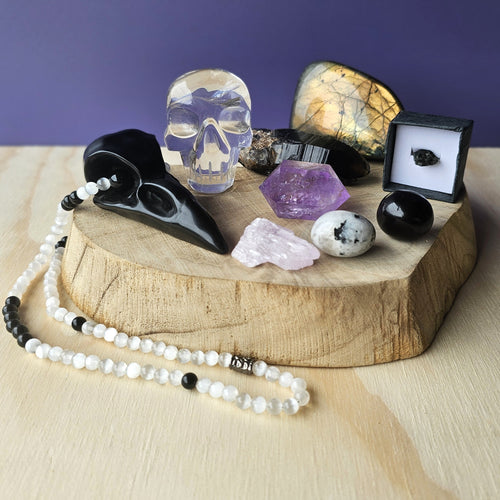
Our Black Obsidian Raven Skull takes the idea even further.
Rather than simply reproducing a human skull, the carving combines a polished skull with a raven bowed over it.
The textured feathers contrast against the smooth Obsidian skull below, turning the piece into a small sculptural story.
Ravens themselves have carried many different meanings across cultures and traditions, so we don't assign one universal ancient meaning to that combination.
For us, it can invite ideas around intelligence, mortality, remembrance, transformation and mystery.
But ultimately, the interpretation belongs to the person looking at it.
Master Carving & Choosing the Right Stone
An exceptional carver isn't simply creating the same skull over and over again in different materials.
The stone needs to be considered.
Where are the inclusions?
Where does the colour sit?
Is there a phantom that should remain visible?
Will a particular orientation show Rutile more beautifully?
Does the material contain natural features that could become part of the skull's character?
The best carvings feel as though the material and form belong together.
This is particularly important to us when choosing significant pieces for Divine Crystal Heart.
We don't want a beautiful piece of mineral sacrificed to an ordinary carving.
And we don't want extraordinary carving wasted on material that doesn't allow the workmanship to be appreciated.
The magic, if we're going to use that word, is when both happen together.
Why Are Some People Drawn to Crystal Skulls?
I don't think there is one answer.
Some people love the anatomy.
Some appreciate the carving skill.
Some are fascinated by mortality and symbolism.
Some connect with the metaphysical meaning of the crystal.
Some associate skulls with ancestors, loved ones or remembrance.
Some simply like things that are a little darker and more unusual.
And some describe a very immediate connection with a particular skull.
I've experienced that myself now.
I used to wonder:
Is it the crystal I'm feeling?
Or is it the skull?
These days I don't think I need to answer that question.
Perhaps it's the combination.
Perhaps it's memory.
Perhaps it's symbolism.
Perhaps it's something spiritual.
Perhaps sometimes a beautifully carved piece of crystal simply reaches a part of us that doesn't communicate particularly well in words.
I'm comfortable leaving a little room for mystery.
How Do I Choose a Crystal Skull?
If you're choosing from a collector's perspective, begin with the material.
Look at clarity, colour, inclusions, pattern, geological features and overall mineral quality.
Then examine the carving.
Look at proportion.
Look at the jaw.
The teeth.
The eye sockets.
The cheekbones.
Consider whether the carving works with the natural stone.
If you're choosing metaphysically, you may also consider the modern associations of the crystal itself.
Clear Quartz is commonly associated with clarity and amplification.
Smoky Quartz with grounding.
Obsidian with protection and introspection.
Citrine with confidence and abundance.
Rutilated Quartz with energy and direction.
But don't underestimate the simplest method.
Look at them.
Which one keeps pulling your attention back?
Sometimes we've had customers analyse five different pieces only to eventually choose the first skull they picked up.
Apparently the skull had already made the administrative decision. 😂
Where Should I Display a Crystal Skull?
There is no historically required place to display a modern Crystal Skull.
From a collector's perspective, place it somewhere the carving and mineral can be appreciated properly.
Lighting can make an enormous difference, particularly with transparent Quartz, Rutile, Fluorite, Agate and other materials with interesting internal features.
Larger skulls can work beautifully as standalone sculptural pieces.
Smaller skulls can be incorporated into mineral cabinets, shelves, desks or crystal displays.
Those who work with Crystal Skulls spiritually may choose to place them in meditation spaces, beside other meaningful crystals or somewhere they regularly spend quiet time.
The placement should make sense for you rather than obeying an internet rule somebody invented last Thursday. 😂
Caring for a Crystal Skull
Care depends primarily on the material from which your skull is carved.
"Crystal" is an enormous category and different minerals have different hardness, stability and sensitivity.
Avoid assuming that every Crystal Skull can be cleaned in water, placed in sunlight or exposed to cleaning products.
For most carved pieces, gentle dusting with a soft dry cloth is a sensible starting point.
If you're unsure about a particular mineral, check its individual care requirements before using water or other cleaning methods.
And with heavier skulls, always support the piece properly when moving it.
Gravity remains considerably less metaphysical than the rest of this article. 😂
My Relationship With Crystal Skulls Today
My relationship with skulls is completely different now.
I can appreciate their carving.
Their mineral quality.
Their symbolism.
Their history.
And yes, their energy too, because that's part of how I personally experience crystals.
But underneath all of that sits something much simpler.
They remind me of Martin.
Not because I think every skull represents him.
Not because I need anyone else to believe what I experienced that day.
But because one stranger, standing beside a table filled with Crystal Skulls, helped a memory surface that I had somehow buried alongside my grief.
That memory changed the symbol.
Something I had associated with death became connected with somebody's life.
And perhaps that's what symbols have always done.
Their meaning isn't permanently locked inside them.
We bring part of ourselves to them too.
Today, when I look at an extraordinary Crystal Skull, I no longer immediately think of death.
I think about the person who carved it.
The extraordinary piece of Earth it was carved from.
The millions of years of geological history held within that material.
I think about the person who will eventually connect with it.
And sometimes I think about a man with a skull tattoo who would probably have driven me mad trying to claim the best ones before we could put them online. 😂❤️
Martin would have loved them.
And now I do too.
You can explore our Crystal Skulls collection and discover the different minerals, carving styles and personalities within our range.
Crystal Skull FAQs
Are Crystal Skulls ancient?
Skull imagery is ancient and appears in many cultures, but the famous large rock-crystal skulls once claimed to be ancient Aztec, Maya or other pre-Columbian artefacts have not been authenticated as such through archaeological evidence.
Scientific examination of studied examples has identified evidence of relatively modern lapidary tools, with researchers generally placing their manufacture in the nineteenth century or later.
Modern Crystal Skulls are contemporary mineral carvings.
Did the Aztecs and Maya use skull imagery?
Yes. Skull imagery had genuine significance within several Mesoamerican cultures.
Tzompantli, for example, were structures associated with the display of human skulls and formed part of complex ritual systems involving sacrifice, religion, cosmic order and cycles of death and renewal.
That genuine archaeological history should be distinguished from later claims that the famous large Quartz Crystal Skulls were ancient Mesoamerican artefacts.
What are the thirteen Crystal Skulls?
The story of thirteen ancient Crystal Skulls that supposedly contain knowledge or will reunite at a significant moment for humanity belongs to modern Crystal Skull legend and New Age spirituality.
There is no archaeological evidence establishing an ancient Mesoamerican tradition involving thirteen Quartz skulls.
What does a Crystal Skull symbolise?
There is no universal meaning.
Historically, skull imagery has represented different concepts in different cultures, including mortality, remembrance, sacrifice, renewal and impermanence.
Within modern crystal spirituality, Crystal Skulls may be associated with transformation, wisdom, consciousness, ancestral connection or meditation.
For many collectors, however, they are simply extraordinary examples of mineral carving.
Are Crystal Skulls associated with death?
They can be, but death is only one possible interpretation.
Historically, skull imagery has also been used to encourage reflection on life, memory, renewal and the passage of time.
Personal experiences can also completely change what a skull represents to an individual.
What does memento mori mean?
Memento mori is a Latin phrase meaning approximately "remember that you must die".
Skulls and other symbols of passing time were used within European art and objects as reminders of mortality and the temporary nature of earthly life.
Rather than simply glorifying death, the symbolism encouraged reflection on how life was being lived.
What makes a high-quality Crystal Skull?
Look at both the mineral and the carving.
High-quality pieces may demonstrate strong anatomical proportions, carefully defined teeth and jaw structure, good polishing and thoughtful orientation of the stone.
For collector pieces, natural mineral features such as Rutile, phantoms, colour zoning, inclusions or transparency can make the carving considerably more interesting.
Why are some Crystal Skulls called Master Carved?
Master Carved generally refers to pieces produced by particularly skilled carvers and displaying a higher level of detail, proportion and finishing than standard commercial carvings.
Because the term isn't a universal geological grading system, the quality of the actual carving should always be considered rather than relying on the title alone.
What is the best crystal for a skull?
There isn't one.
Clear Quartz can showcase internal features beautifully.
Smoky Quartz creates depth.
Rutilated Quartz can contain spectacular needle-like inclusions.
Obsidian provides a dark glassy surface ideal for dramatic carving.
Jasper, Agate and many other materials introduce their own colours and patterns.
The best choice depends on whether you're most interested in mineral quality, carving, symbolism or simply the piece you're drawn to.
Can Crystal Skulls be used for meditation?
Within contemporary crystal practices, some people use Crystal Skulls during meditation, intention setting or personal spiritual work.
These practices are modern metaphysical traditions rather than scientifically established properties of Crystal Skulls.
Others collect them purely for their mineral and sculptural qualities.
Where should I place my Crystal Skull?
There is no compulsory placement.
Display it somewhere safe where you can appreciate the mineral and carving.
If it has personal or spiritual significance for you, you may prefer a meditation space, crystal display or another area where you regularly spend time.
How do I know which Crystal Skull is right for me?
Look at the crystal first.
Look at the carving.
Read about the mineral.
Consider why you're drawn to it.
And then allow yourself to choose without needing to justify every part of the decision.
Sometimes the pieces that mean the most to us aren't the ones we can explain most easily.
I certainly learnt that lesson the long way around.