Facebook Live Sale Wednesday October 21 @ 6PM QLD


There are times when a space simply feels as though it needs a reset.
Perhaps you've moved into a new home, had a difficult week, welcomed a lot of people through your space or simply reached one of those moments where opening the windows and starting fresh feels incredibly good.
For centuries, aromatic plants, woods and resins have been burned across many different cultures as part of spiritual, ceremonial and everyday practices.
Today, two of the most familiar are Sage and Palo Santo.
Both are commonly used in contemporary smoke-cleansing rituals, but they are different plants with different histories, aromas and traditions behind them.
Whether your ritual is deeply spiritual or simply a quiet moment to reset your space and intentions, understanding what you're burning can make the experience considerably more meaningful.
What Is Sage?
Sage belongs to a large group of aromatic plants, with different species growing naturally in different parts of the world.
One particularly well-known species used for smoke cleansing is White Sage, Salvia apiana, an aromatic plant native primarily to Southern California and extending into Baja California.
Its pale, silvery leaves contain naturally aromatic compounds that produce its distinctive fragrance when the dried leaves are burned.
White Sage also has important cultural significance within the traditions of a number of Indigenous peoples of North America, where sage and other plants have been used in ceremonial, spiritual and cleansing practices.
This history is worth acknowledging rather than reducing Sage to simply another home fragrance.
Today, many people outside these traditions also burn Sage as part of their own personal smoke-cleansing, meditation or intention-setting practices.
You can explore our Sage for your own cleansing and intention rituals.
Why Do People Burn Sage?
In contemporary spiritual practice, Sage is commonly burned with the intention of cleansing or resetting the atmosphere of a space.
For some people, this is energetic.
For others, the ritual itself is what matters.
Lighting the Sage, opening a window, walking slowly through your home and consciously deciding that you're ready to let something go can create a very definite moment between what came before and what comes next.
And sometimes we need those moments.
People may choose to burn Sage when:
- moving into a new home
- cleansing a room after visitors
- beginning or finishing a meditation
- working with crystals
- creating a fresh atmosphere after a stressful period
- setting intentions
- beginning a new chapter
- simply feeling that their space needs a reset
You don't need an elaborate ceremony.
Intention can be as simple as deciding what you want to leave behind and what you would like to welcome in instead.
Smoke Cleansing, Smudging & Respectful Terminology
The words "smudging" and "smudge stick" are now commonly used throughout the wellness and crystal industries, but there is an important distinction worth understanding.
Smudging can refer specifically to ceremonial practices belonging to particular Indigenous cultures of North America. These traditions carry their own protocols, teachings and cultural significance.
For a personal practice at home, we generally prefer the broader terms smoke cleansing or Sage cleansing.
It doesn't make the ritual less meaningful.
It simply recognises that our personal practices aren't necessarily the same as the traditional ceremonies from which some of today's terminology has been borrowed.
We think understanding where traditions come from adds meaning rather than taking anything away from them.
How to Burn Sage
You don't need much to create a simple Sage cleansing ritual.
Before lighting your Sage, decide what you would like the ritual to represent.
Perhaps you want to release the heaviness of a difficult week.
Maybe you're settling into a new home.
Perhaps you've cleaned the entire house and this is the final step.
Or maybe life has simply been a little chaotic and you're declaring, "Right. We're starting again." 😂
Open a window or door to provide ventilation and give the smoke somewhere to move.
Light the end of your Sage stick carefully and allow it to catch briefly before gently blowing out the flame.
The Sage should smoulder rather than continue burning with an open flame.
Place a heat-resistant dish beneath it to catch any falling ash or embers.
Move calmly through the space, allowing a small amount of smoke to move through the areas you wish to cleanse.
You might remain silent, repeat an affirmation, say a prayer or simply hold your intention in mind.
When you've finished, extinguish the Sage completely in a suitable fire-safe container and make sure there are no remaining embers.
A little smoke goes a long way.
You do not need to turn the lounge room into a mystical fog bank. 😂
Setting an Intention While Cleansing
This is where a simple ritual can become something personal.
Before you begin, think about what you're actually trying to create.
If you're releasing something, your intention might be:
"I release what no longer belongs in this space."
If you're beginning again:
"I welcome peace, clarity and positive new beginnings into my home."
For abundance:
"May this space support growth, opportunity and abundance."
Or forget the formal wording entirely.
"This week has been ridiculous. We are resetting." is also a perfectly understandable intention. 😂
The words aren't the important part.
The meaning behind them is.
Can I Use Sage to Cleanse My Crystals?
Smoke cleansing is also commonly used within modern crystal practices.
Rather than physically washing a crystal, which isn't suitable for every mineral, some people briefly pass their crystals through the smoke from Sage while setting an intention to cleanse or reset them energetically.
This can be particularly useful for mixed crystal collections because minerals vary considerably in their tolerance of water, salt, sunlight and other physical cleansing methods.
From a mineral-care perspective, smoke cleansing has the advantage of not requiring crystals to be submerged or exposed to potentially damaging cleaning substances.
Metaphysically, whether you consider that an energetic cleanse is entirely personal.
But as a quiet ritual for reconnecting with a crystal, it can be rather lovely.
What Is Palo Santo?
Palo Santo means "holy wood" or "sacred wood" in Spanish and commonly refers to the aromatic wood of Bursera graveolens.
The tree grows naturally in parts of the tropical dry forests of South America, including Ecuador and Peru.
When burned, Palo Santo produces a distinctive woody fragrance that can be sweet, warm, resinous and slightly citrus-like.
It has a completely different personality from Sage.
Where Sage can produce a stronger herbal smoke, Palo Santo is often chosen by people who enjoy a warmer woody aroma and a slower, more focused ritual.
Our Palo Santo can be used for personal smoke-cleansing and intention rituals.
Why Do People Burn Palo Santo?
Palo Santo has a long history of traditional use in parts of South America and today is widely used in contemporary spiritual and wellness practices.
Modern users commonly burn it during:
- meditation
- intention setting
- yoga or spiritual practice
- crystal rituals
- smoke cleansing
- quiet reflection
- creating a calm atmosphere
Some people use Palo Santo to clear a space in much the same way they use Sage.
Others think of it slightly differently, using Sage when they want a stronger sense of clearing and Palo Santo when they want to introduce warmth, intention and a calmer atmosphere afterwards.
That distinction belongs largely to modern spiritual practice rather than being a universal historical rule, but it can be a lovely way to build your own ritual.
Sage vs Palo Santo: What's the Difference?
Although Sage and Palo Santo are often placed together, they aren't interchangeable.
Sage is a leafy aromatic plant.
Palo Santo is an aromatic wood.
Their fragrances are very different, their cultural histories are different and even the experience of burning them is different.
Sage generally produces a stronger herbal aroma and more immediate smoke.
Palo Santo tends to burn for a short period before naturally going out, producing a warmer woody fragrance.
From a modern metaphysical perspective, Sage is frequently associated with clearing and releasing, while Palo Santo is often associated with restoring, grounding and welcoming positive intention.
You don't have to choose one permanently.
Some people prefer Sage.
Some prefer Palo Santo.
And some apparently looked at the decision and said, "I'll take both." 😂
Can You Use Sage and Palo Santo Together?
Yes, within a personal contemporary ritual you can certainly choose to use both.
One popular approach is to begin with Sage as the symbolic clearing stage.
Move through your space slowly, focusing on what you are ready to release.
Allow fresh air through the room.
Then, once the Sage ritual is complete, light Palo Santo and focus instead on what you would like to welcome into the space.
Peace.
Love.
Clarity.
Abundance.
Protection.
Creativity.
Whatever feels relevant to you.
Think of it as creating space first, then deciding what you'd like that space to hold.
Again, there is no universal ancient rule saying this is how Sage and Palo Santo must be used together.
It is simply a meaningful way to structure a modern personal ritual.
How to Burn Palo Santo
Light one end of your Palo Santo stick carefully.
Allow the flame to burn briefly before blowing it out so the wood begins to smoulder.
You can then allow the fragrant smoke to move gently through your space, around your crystals or near the area where you meditate or set intentions.
Palo Santo often goes out naturally and may need to be relit during a longer ritual.
That's normal.
It isn't being difficult. 😂
When finished, place it in a heat-resistant container and ensure it is completely extinguished.
Because Palo Santo sticks are generally used gradually rather than burned completely in one sitting, the same piece may be relit on multiple occasions.
When Should I Cleanse My Space?
There isn't a schedule.
Your home does not require Sage every second Tuesday at 7:14 pm. 😂
Many people simply cleanse when it feels appropriate.
That might be after an argument or stressful period.
It could be before meditation, after having visitors, when moving house or when beginning something new.
Some people create regular rituals around the new moon, full moon or beginning of a month.
Others might go months without doing it.
The ritual should support you rather than become another obligation on the calendar.
Smoke Cleansing a New Home
Moving into a new home is one of the most popular times to create a cleansing ritual.
Even without any metaphysical beliefs, there is something symbolic about acknowledging that one chapter has ended and another is beginning.
Open the doors and windows where practical.
Walk slowly through the home.
Take notice of each room.
Think about how you want the space to feel.
Peaceful?
Safe?
Creative?
Full of laughter?
Prosperous?
Calm?
A home is more than its walls and furniture.
The rituals we create when entering it can help us decide what we want that home to become.
Sage, Palo Santo & Crystal Rituals
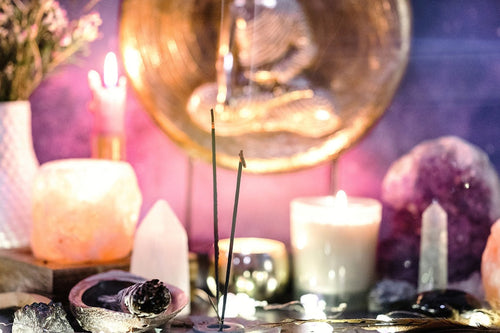
Crystals, Sage and Palo Santo are often brought together in contemporary spiritual practice because each can become part of a wider intention ritual.
You might choose a crystal associated with what you're working towards, cleanse your space with Sage, light Palo Santo while setting your intention and then place the crystal somewhere meaningful.
If cleansing is part of your crystal or spiritual practice, you can also explore our Cleansing Collection for other ways to create a ritual that feels right for you.
Using Smoke Safely
Sage and Palo Santo both involve burning plant material, so practical safety comes before ritual.
Always use a heat-resistant dish or suitable burner.
Keep burning materials away from curtains, paper, clothing and other flammable objects.
Never leave Sage or Palo Santo burning unattended.
Use them in a well-ventilated space and avoid deliberately filling a room with smoke.
Be considerate of anyone in the household who may be sensitive to smoke or fragrance.
And always ensure everything is completely extinguished when your ritual is finished.
A cleansing ritual should improve the atmosphere of the house.
Setting the curtains on fire would rather defeat the purpose. 😂
Creating a Ritual That Feels Like Yours
One of our favourite things about personal rituals is that they don't have to be elaborate.
You don't need perfect words.
You don't need an impressive altar.
You don't need to perform something you've watched somebody else do online.
You can open a window.
Light your Sage or Palo Santo.
Take a few quiet minutes.
Think about what you are ready to release.
Think about what you want more of.
And begin again.
There is something powerful about consciously deciding that a moment marks a change, even when the ritual itself is very simple.
Perhaps that's why practices involving fragrance, smoke, plants, woods and resins have remained meaningful to people across so many cultures and generations.
The objects may differ.
The traditions may differ.
But the human desire to pause, reset and give meaning to a moment is remarkably familiar.
Sage & Palo Santo FAQs
What is Sage used for spiritually?
Within contemporary spiritual practices, Sage is commonly burned during smoke cleansing, meditation and intention setting.
It is often associated with releasing unwanted energy and creating a sense of a fresh beginning.
Sage also has important ceremonial significance within a number of Indigenous North American cultures, whose traditional practices should be distinguished from general contemporary smoke cleansing.
Is smoke cleansing the same as smudging?
Not necessarily.
"Smudging" can refer to specific ceremonial practices belonging to Indigenous cultures of North America.
For general personal rituals performed outside those traditions, terms such as smoke cleansing or Sage cleansing can be more appropriate.
What is Palo Santo used for?
Palo Santo is an aromatic wood traditionally used in parts of South America and widely used today in contemporary meditation, spiritual and smoke-cleansing practices.
Modern users often associate its warm woody fragrance with grounding, intention setting and creating a calm atmosphere.
Which is better, Sage or Palo Santo?
Neither is inherently better.
They are different plants with different aromas, histories and styles of use.
Sage generally has a stronger herbal fragrance, while Palo Santo produces a warmer woody aroma.
Your preference may depend simply on which experience you enjoy.
Can I use Sage and Palo Santo together?
Yes, within a contemporary personal ritual.
Some people choose to use Sage first while focusing on releasing or clearing, followed by Palo Santo while focusing on what they would like to welcome into their space.
This is a modern ritual approach rather than a universal traditional rule.
Can I cleanse crystals with Sage or Palo Santo?
Smoke cleansing is commonly used within modern crystal practices because it doesn't require crystals to be immersed in water or exposed to salt.
Some people briefly move their crystals through the smoke while setting an intention to energetically cleanse or reset them.
Do I need to burn the whole Sage stick?
No.
You can extinguish a Sage stick once your ritual is complete and use the remainder another time.
Always ensure there are no remaining embers before storing it.
Why does my Palo Santo keep going out?
That's normal.
Palo Santo typically burns briefly and then continues to smoulder before going out. It may need to be relit several times during a longer ritual.
Do I need to say anything while burning Sage?
No.
Some people use affirmations, prayers or spoken intentions, while others prefer silence.
There is no requirement to use particular words during your own personal smoke-cleansing practice.
How often should I cleanse my home?
There is no required schedule.
Some people cleanse regularly, while others use Sage or Palo Santo only when their space feels as though it needs a reset or when marking a new beginning.
The practice can be as frequent or occasional as feels meaningful to you.